The Ruins of 1934: A Legacy of Grassroots Solidarity
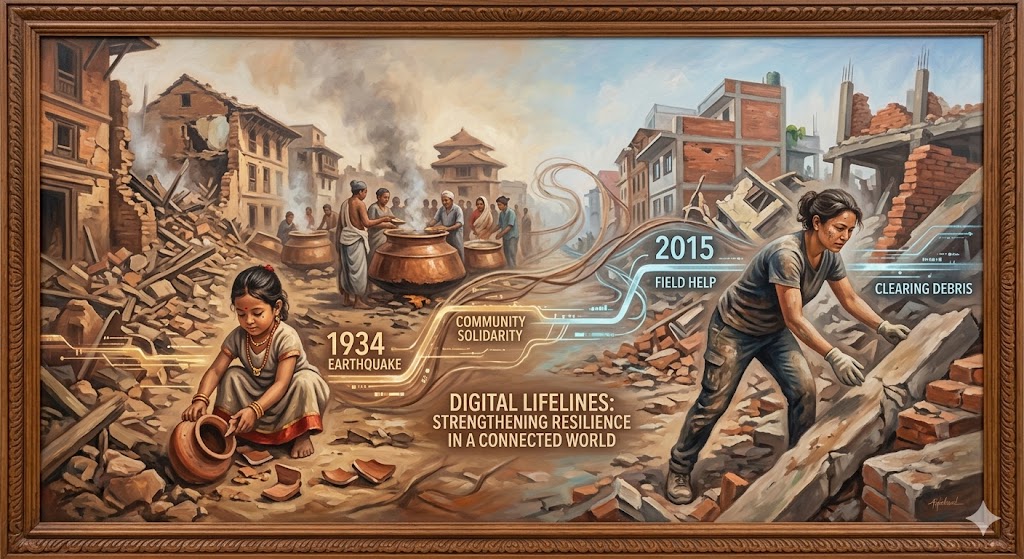
My late mother, Heera Devi Yami, was a survivor of the devastating 1934 earthquake in Nepal. She was just a small child at the time, living in Bhansa-Chhen, Kel Tole, Kathmandu—one of the most heavily affected areas of the city. She often recalled how entire neighborhoods were reduced to rubble and how, as children, they would innocently play among the ruins, unable to fully comprehend the scale of the tragedy around them.
Yet alongside the destruction, she also remembered extraordinary acts of community solidarity and compassion. Coming from a Lhasa Newar family connected to Bhansa-Chhen, her family members participated actively in supporting earthquake survivors. They prepared tea and food using massive, traditional hand-hammered copper vessels known as khasi—large copper water-storage and brewing vessels traditionally used in Tibetan and Himalayan communities to prepare large quantities of beverages during major festivals and monastery gatherings.
Throughout the disaster and the long recovery period, these Lhasa Newar families organized grassroots support for victims, serving food and helping neighbors survive the bitterest of times. In an era devoid of modern disaster management systems, digital communication, or organized humanitarian infrastructure, communities themselves became the ultimate lifeline.
These stories left a deep impression on me, but it was decades later that I truly understood their weight. During the 2015 earthquake in Nepal, I was actively engaged in relief work across the devastated sites of the Kathmandu Valley. Witnessing the horrific destruction firsthand, I worked directly in the debris-filled streets—helping to clear houses, navigating blocked pathways, and confronting the immense trauma and human suffering of the moment.
In those dark, chaotic hours on the ground, the abstract stories of my childhood became a vivid reality. I saw the exact same enduring spirit of resilience, courage, and collective care that my mother had described from 1934. It was not top-down infrastructure that saved lives in those initial, critical hours; it was ordinary people stepping into the ruins to lift the weight off one another.
The Power of Rationality: The Astrological Panic of 1961
Late in 2018 B.S. (early 1962 CE), a different kind of crisis gripped Nepal. A wave of widespread public fear spread due to ominous rumors and astrological predictions warning that a catastrophic earthquake would strike on a specific date. Fueled by word of mouth and fatalistic religious interpretations, anxiety spread like wildfire across the country.
In a sweeping panic, numerous families donated their hard-earned money, valuables, food, and jewelry to pandits and priests, believing these rituals could avert the predicted disaster. Fear completely overwhelmed rational judgment. A large portion of the public placed their trust in supernatural assurances rather than scientific understanding or practical preparedness, leaving themselves vulnerable to exploitation.
As the dreaded date approached, the hysteria intensified. Neighbors and acquaintances abandoned their homes to seek refuge in open spaces. In Bhurungkel, relatives and neighbors pitched temporary tents, sleeping for days outdoors in the open compound of our family residence. Terrified that their houses would collapse, entire communities lived in a state of acute psychological distress.
During this mass panic, my parents, Dharma Ratna Yami and Heera Devi Yami, stood firmly apart. Guided by reason, they refused to buy into the fear-driven claims propagated by religious figures. They were deeply disturbed to see vulnerable, frightened people being manipulated into handing over their resources in exchange for empty promises of divine protection.
At the time, we seven children were staying on the fourth floor of our house. At night, some of the neighbors staying in the tents downstairs would come up to our floor, pleading with my parents to at least send the children down to sleep outside. "Even if you do not fear death," they begged, "save the children from the coming earthquake."
But my parents calmly and resolutely refused. They maintained that the panic was entirely irrational and that the public was being manipulated by fear and misinformation. Onlookers were shocked by their defiance, unable to comprehend how they could remain so calm amidst such widespread chaos.
Finally, the predicted date arrived. The city was thick with the sound of intense prayers, final rituals, and priests collecting last-minute offerings. Yet, the day passed quietly. No earthquake came. Nothing happened.
This incident remains a stark revelation of how easily fear and misinformation can weaponize a society when scientific literacy and public awareness are limited. It demonstrated how crises—or even the mere rumor of a crisis—can be exploited for financial gain and psychological control. Above all, my parents’ courage left an indelible mark on me, proving that societies require critical thinking, ethical leadership, and emotional resilience to resist manipulation. It stands as a timeless historical reminder that mass panic and widespread belief do not make a rumor true, and that an objective, rational mindset remains our best defense against collective hysteria.
Chronicling History from the Margins
The poets, the rebels, the mothers who held everything together—none of it made the official school curriculum. Documenting history from the margins requires a deliberate shift in strategy. Institutional records naturally overlook grassroots leaders and cultural innovators in favor of official milestones and state decrees. However, the true engine of societal survival has always lived in oral traditions and undocumented community organizing.
Reclaiming this narrative means we can no longer rely on passive memory; we must build the digital and structural infrastructure necessary to archive, protect, and pass down the truth of how communities actually survive.
Historically, across the globe, this was a dangerous task. Those who questioned ancestral traditions or state narratives could be banished or eliminated. In ancient Greece, Socrates was sentenced to death for "corrupting the youth" with his uncomfortable questions. During the Middle Ages, the Catholic Church created an elaborate system to identify and suppress heresy—burning not only books, but also the people who dared to think outside established dogmas. In the 20th century, totalitarian regimes perfected mind control techniques that led populations to internalize censorship so deeply that they didn't even realize they were being controlled.
But what we are living through today represents a qualitative, much more subtle evolution of these historical methods of control.
The Mechanics of Modern Control: From Force to Frictionless
Historically, censorship was visible, heavy-handed, and centralized. It relied on the executioner's blade, the inquisitor's fire, or the state's secret police. Today, control has evolved from an external threat into a seamless, decentralized, and highly psychological digital environment.
Unlike totalitarian regimes that stripped away information, the modern landscape floods the digital sphere with an overwhelming surplus of data. Control is no longer achieved by silencing voices, but by drowning out nuance within algorithmic echo chambers. Where the Inquisition required an active apparatus of spies, modern algorithms track every click, scroll, and pause. They predict psychological vulnerabilities and feed users personalized content designed to trigger outrage, anxiety, or confirmation bias—effectively outsourcing censorship to automated code.
Instead of physical banishment, dissenting or unconventional ideas face digital ostracization through shadow banning, algorithmic demotion, and systemic de-platforming. When algorithms dictate the boundary lines of public discourse, critical thinking is reduced to a pre-programmed response. To resist this qualitative shift in control, society requires an intentional commitment to digital hygiene and an active resistance to automated thinking.
Digital Lifelines: Strengthening Resilience in a Connected World
As humanity enters the age of Artificial Intelligence and rapid digital transformation, these historical lessons take on a vital new dimension. In our hyper-connected world, digital networks and AI have become our modern infrastructure—essential public utilities just like the roads, water systems, and power grids of the past. They are the new networks through which human society coordinates, communicates, and survives.
However, a connected world is also a vulnerable one. Algorithms can now spread misinformation far faster than the word-of-mouth rumors of 1961, creating instantaneous mass fear, confusion, and systemic instability on a global scale. If left unregulated and driven solely by rapid technical deployment, these platforms can dismantle social trust and exploit psychological vulnerabilities.
To counter this, we must intentionally design "Digital Lifelines"—technology frameworks rooted in a sense of Digital Dharma, where ethical accountability, transparency, and human-centric guardrails are paramount. Building true systemic resilience requires us to bridge the gap between rapid technological breakthroughs and slower, necessary ethical governance.
True digital resilience is not just about static AI security or tech-driven automation; it is about building operational resolving power and strengthening our collective capacity to withstand shocks. This means moving academic systems away from rote memorization toward robust, inclusive STEAM models that cultivate scientific literacy and digital hygiene. Simultaneously, we must use technology to support and scale local caregiver collectives and mutual-aid groups—turning the informal community solidarity of 1934 into resilient digital infrastructure, and insisting that structural systems and corporate mandates actively invest in the safety, public trust, and psychological security of the societies they serve.
Technology alone is never enough. During crises, societies survive through compassion, emotional support, social trust, and community solidarity. Digital lifelines must be built to amplify these human virtues, not weaken them. Whether confronting a physical disaster like 1934 or an algorithmic panic like the ones threatening our modern landscape, our truest anchors remain critical thinking, ethical governance, and our fundamental capacity to care for one another.
The Fragility of Our New Enlightenment
The digital infrastructure replacing old superstitions is far more delicate than it seems. The transition from isolation to connectivity relies on physical vulnerabilities that cross borders and affect the most vulnerable first. We think of the "cloud" as ethereal, but it is deeply physical. Over 1.7 million kilometers of undersea fiber-optic cables form the literal nervous system of global civilization. When an earthquake triggers underwater landslides (such as those off the coast of Taiwan or the Mediterranean), or a ship anchors in the wrong place, entire nations can plunge into digital darkness.
For a landlocked or developing region, losing these links shuts down banking, emergency responses, and access to life-saving information. The internet age faces threats that are literally cosmic. A massive coronal mass ejection (solar storm)—similar to the Carrington Event of 1859—could induce currents that fry electrical grids, disable satellite navigation (GPS), and knock out long-distance communication systems for months.
When networks fail, the richest nations have redundancy. But for a farmer using a mobile wallet to sell crops, or a remote clinic relying on telemedicine to treat a patient, a network collapse is a direct threat to survival. The consequences fall hardest on those who can least afford them.
Connectivity is no longer a luxury or a mere convenience; it is a fundamental human lifeline. To protect rural communities from slipping back into isolation or falling victim to misinformation, the global community must invest in redundant, "resilient-by-design" infrastructure.
True digital sovereignty means ensuring that the systems keeping us informed, rational, and connected can withstand both terrestrial shocks and cosmic weather. Together, through capacity building and global cooperation, we can keep those digital lifelines open for everyone, everywhere.
Conclusion
My family’s lived history seamlessly translates into a modern framework for digital ethics and societal resilience. My parents’ lives provided the ultimate case studies for the very concepts I grapple with today: my mother’s experience in 1934 is the definition of decentralized, grassroots mutual aid, and my parents' stand in 1961 is a masterclass in maintaining information hygiene and an "observer mindset" in the face of algorithmic-style social contagion. It honors their legacy by turning their lived actions into a blueprint for a safer, more rational, and deeply compassionate digital world.
.
---------------------NOTE ---------------------------
Please note that the Nepali version of this article was translated using an AI tool and may require further editing. Readers are kindly advised to review the translation with care.
कृपया ध्यान दिनुहोला, यस लेखको नेपाली संस्करण एउटा एआई (AI) उपकरण प्रयोग गरेर अनुवाद गरिएको हो र यसमा थप परिमार्जन (सम्पादन) आवश्यक हुन सक्छ। पाठकवर्गलाई नेपाली अनुवाद सावधानीपूर्वक पढिदिनुहुन हार्दिक अनुरोध छ।
____________________________________________________________________
उत्थानशीलता र विवेकशीलताका पाठहरू: १९९० को भग्नावशेषदेखि एआई (AI) को युगतसम्म
१९९० को भग्नावशेष: भुइँतहको ऐक्यबद्धताको विरासत
मेरो स्वर्गीय आमा हीरदेवी यमी वि.सं. १९९० को विनाशकारी महाभूकम्पको जीवित साक्षी हुनुहुन्थ्यो। त्यतिबेला उहाँ सानै हुनुहुन्थ्यो र काठमाडौँको सबैभन्दा बढी प्रभावित क्षेत्रमध्येको एक केलटोलस्थित 'भन्सा-छें' (भन्सार घर) मा बस्नुहुन्थ्यो। आमाले प्रायः स्मरण गर्नुहुन्थ्यो कि कसरी सिङ्गो टोल भग्नावशेषमा परिणत भएको थियो र बालबालिकाहरू भने आफ्नो वरिपरिको महाविपद्को गहिराइलाई बुझ्न नसकी तिनै भग्नावशेषहरूका बीच अबोध रूपमा खेल्ने गर्दथे।
तर, त्यस विनाशका बीच पनि आमाले समुदायमा प्रकट भएको अभूतपूर्व ऐक्यबद्धता र करुणाका कथाहरू सम्झनुहुन्थ्यो। भन्सा-छेंसँग जोडिएको ल्हासा नेवार परिवारको पृष्ठभूमि भएकाले उहाँका परिवारका सदस्यहरू भूकम्प पीडितहरूको सहयोगमा सक्रिय रूपमा जुटेका थिए। उनीहरूले परम्परागत रूपमा हातले ठोकेर बनाइएका तामाका ठूला-ठूला भाँडाहरू, जसलाई 'खासि' भनिन्छ, तिनमा चिया र खाना तयार गर्थे। यी खासिएका ठूला मुख भएका तामाका देक्ची (ग्यालोन) जस्ता भाँडाहरू विशेषगरी तिब्बती तथा हिमाली समुदायहरूमा ठूला चाडपर्व वा गुम्बाहरूका भोजमा धेरै परिमाणमा पेय वा खाद्य सामग्री पकाउन प्रयोग गरिन्थे।
विपद्को समय र त्यसपछिको लामो पुनर्लाभको अवधिभरि, ती ल्हासा नेवार परिवारहरूले पीडितहरूका लागि भुइँतहबाटै राहतको व्यवस्था गरे, खाना खुवाए र छिमेकीहरूलाई त्यो कठिनतम समय पार गर्न मद्दत गरे। आधुनिक विपद् व्यवस्थापन प्रणाली, डिजिटल सञ्चार वा संगठित मानवीय पूर्वाधार नभएको त्यस युगमा समुदाय आफैँ नै मानिसका लागि अन्तिम जीवनरेखा (लाइफलाइन) बनेको थियो।
यी कथाहरूले मेरो मानसपटलमा गहिरो छाप छोडेका थिए, तर यसको वास्तविक वजन भने मैले दशकौँपछि मात्र महसुस गरेँ। वि.सं. २०७२ को भूकम्पको समयमा म काठमाडौँ उपत्यकाका ध्वस्त भएका क्षेत्रहरूमा राहत कार्यमा सक्रिय रूपमा संलग्न थिएँ। त्यो भयानक विनाशलाई आफ्नै आँखाले देख्दा, मैले भग्नावशेषले भरिएका सडकहरूमा प्रत्यक्ष काम गरेँ—घरहरू सफा गर्न मद्दत गर्ने, थुनिएका बाटाहरू खोल्ने र त्यस क्षणको अथाह मानसिक आघात र मानवीय पीडाको सामना गर्ने काम गरेँ।
त्यस अँध्यारो र अस्तव्यस्त घडीमा, मेरो बाल्यकालका ती अमूर्त कथाहरू जीवन्त यथार्थ बनेर अगाडि आए। मैले ठ्याक्कै त्यही अथक उत्थानशीलता, साहस र सामूहिक हेरचाहको भावना देखेँ, जुन मेरी आमाले १९९० सालको सन्दर्भमा वर्णन गर्नुभएको थियो। ती प्रारम्भिक र संवेदनशील घण्टाहरूमा मानिसको ज्यान बचाउने काम कुनै माथिल्लो तहको नीतिगत पूर्वाधारले गरेको थिएन; बरु एकअर्काको पीडा कम गर्न भग्नावशेषमा ओर्लिएका आम सर्वसाधारणले गरेका थिए।
विवेकको सामर्थ्य: २०१८ सालको ज्योतिषीय सन्त्रास
वि.सं. २०१८ को उत्तराद्र्ध (सन् १९६२ को सुरुवात) तिर नेपाललाई एउटा फरक प्रकृतिको संकटले घेर्यो। एउटा निश्चित तिथिमा प्रलयकारी भूकम्प आउनेछ भनी फैलाइएका अशुभ हल्ला र ज्योतिषीय भविष्यवाणीका कारण जनमानसमा व्यापक डरको लहर फैलियो। जनश्रुति र भाग्यवादी धार्मिक व्याख्याका भरमा त्यो त्रास डढेलोझैँ देशैभरि फैलियो।
त्यस चौतर्फी सन्त्रासका बीच, अनगिन्ती परिवारहरूले आफ्ना दुःखले कमाएका पैसा, बहुमूल्य गहना, अन्न र धनदौलत पण्डित र पुरोहितहरूलाई दान गरे; उनीहरूलाई लाग्थ्यो कि यी अनुष्ठानहरूले आउन लागेको महाविपत्तिलाई टार्न सक्छ। डरले मानिसको विवेकशील निर्णय क्षमतालाई पूर्ण रूपमा ओझेलमा पारिदियो। जनताको ठूलो हिस्साले वैज्ञानिक बुझाइ वा व्यावहारिक पूर्वतयारीको साटो अलौकिक आश्वासनमाथि भरोसा राखे, जसले गर्दा उनीहरू शोषणको सिकार बन्न पुगे।
भविष्यवाणी गरिएको त्यो भयानक दिन नजिकिँदै जाँदा मानसिक उन्माद अझ तीव्र बन्यो। छिमेकी र चिनजानका मानिसहरू घर भत्किने डरले आफ्ना घरहरू छोडेर खुला ठाउँमा शरण लिन थाले। भुरुङखेलस्थित हाम्रो पारिवारिक निवासको खुला चौरमा आफन्त र छिमेकीहरूले अस्थायी पालहरू टाँगे र धेरै दिनसम्म बाहिरै सुते। आफ्ना घरहरू भत्किनेछन् भन्ने त्रासमा सिङ्गो समुदाय चरम मनोवैज्ञानिक तनावमा बाँचिरहेको थियो।
यस सामूहिक सन्त्रासका बीच, मेरा मातापिता धर्मरत्न यमी र हीरदेवी यमी दृढताका साथ अलग्गै उभिनुभयो। विवेकको मार्ग पक्रँदै उहाँहरूले धार्मिक व्यक्तिहरूद्वारा प्रचारित डर-केन्द्रित दाबीहरूलाई विश्वास गर्न अस्वीकार गर्नुभयो। असहाय र त्रसित मानिसहरूलाई ईश्वरीय रक्षाको खोक्रो आश्वासनको बदलामा आफ्ना स्रोत-साधनहरू सुम्पन बाध्य पारिएको देख्दा उहाँहरू निकै मर्माहत हुनुभएको थियो।
त्यतिबेला हामी सातै जना दाजुभाइ-दिदीबहिनी घरको चौथो तलामा बसिरहेका थियौँ। रातीको समयमा तल पालमा बसेका केही छिमेकीहरू हाम्रो तलामा आएर मेरा मातापितासँग कम्तीमा बच्चाहरूलाई भए पनि बाहिर खुला ठाउँमा सुत्न पठाउन अनुनय-विनय गर्थे। उनीहरू भन्थे, "तपाईंहरू आफू मर्नसँग डराउनुहुन्न भने पनि कम्तीमा यी बच्चाहरूलाई त आउन लागेको भूकम्पबाट बचाउनुहोस्।"
तर मेरा मातापिताले शान्त र दृढताका साथ अस्वीकार गर्नुभयो। उहाँहरूको मान्यता थियो कि यो सन्त्रास पूर्णतया अतार्किक छ र जनमानसलाई डर र भ्रमको भरमा बहकाइएको छ। उहाँहरूको यो आँट र निश्चिन्तता देखेर बाहिरका मानिसहरू अचम्मित पर्थे; यस्तो चौतर्फी कोलाहलका बीच उहाँहरू कसरी यति शान्त रहन सक्नुभएको होला भनी उनीहरू बुझ्न सक्दैनथे।
अन्ततः, भविष्यवाणी गरिएको त्यो दिन पनि आयो। सहरभरि तीव्र प्रार्थना, अन्तिम अनुष्ठान र पुरोहितहरूले हतार-हतार दान दक्षिणा संकलन गरिरहेका आवाजहरू गुञ्जायमान थिए। तैपनि, त्यो दिन शान्तपूर्वक बित्यो। कुनै भूकम्प आएन। केही पनि भएन।
यो घटना वैज्ञानिक साक्षरता र जनचेतना सीमित हुँदा समाजलाई डर र गलत सूचनाका भरमा कति सजिलै हतियार बनाउन सकिन्छ भन्ने कुराको एउटा बलियो दृष्टान्त हो। यसले प्रमाणित गर्यो कि संकट—वा संकटको एउटा सामान्य हल्ला मात्रै पनि—कसरी आर्थिक लाभ र मनोवैज्ञानिक नियन्त्रणका लागि दुरुपयोग हुन सक्छ। सबैभन्दा महत्त्वपूर्ण कुरा, मेरा मातापिताको त्यस साहसले ममा एउटा अमिट छाप छोड्यो; यसले सिद्ध गर्यो कि भ्रम र प्रलोभनको प्रतिरोध गर्न समाजलाई आलोचनात्मक सोच (क्रिटिकल थिङ्किङ), नैतिक नेतृत्व र भावनात्मक दृढता आवश्यक पर्छ। यो घटनाले एउटा शाश्वत ऐतिहासिक पाठ सिकाउँछ: सामूहिक डर र व्यापक विश्वासले मात्रै कुनै हल्ला सत्य साबित हुँदैन, र सामूहिक मानसिक उन्मादविरुद्ध वस्तुपरक एवं तर्कसंगत मानसिकता नै हाम्रो सबैभन्दा उत्तम प्रतिरक्षा हो।
सीमान्तबाट इतिहासको अभिलेखीकरण
ती कविहरू, ती विद्रोहीहरू, र परिवार एवं समाजलाई थामेर राख्ने ती आमाहरू—यी कसैका कथाहरू पनि विद्यालयको आधिकारिक पाठ्यक्रममा परेनन्। सीमान्तकृत आवाजहरूबाट इतिहासको अभिलेखीकरण गर्न रणनीतिक रूपमा सचेत प्रयासको आवश्यकता पर्छ। संस्थागत अभिलेखहरूले स्वाभाविक रूपमा आधिकारिक कोशढुङ्गा र राज्यका डिक्री (आदेश) हरूको पक्षमा भुइँतहका नेता र सांस्कृतिक नवप्रवर्तकहरूलाई उपेक्षा गर्छन्। तर, समाजको अस्तित्व जोगाउने वास्तविक इन्जिन त सधैँ मौखिक परम्परा र अभिलेखीकरण नभएका सामुदायिक संगठनहरूमा नै जीवित रहेको हुन्छ।
यो भाष्यलाई पुनस्र्थापित गर्नुको अर्थ अब हामी निष्क्रिय सम्झनामा मात्र भर पर्न सक्दैनौँ; समुदायहरू वास्तवमा कसरी संकटमा जोगिए भन्ने सत्यलाई अभिलेख राख्न, सुरक्षित गर्न र भावी पुस्तामा हस्तान्तरण गर्न आवश्यक डिजिटल र संरचनात्मक पूर्वाधार निर्माण गर्नैपर्छ।
ऐतिहासिक रूपमा हेर्दा, यो एउटा जोखिमपूर्ण काम थियो। पुर्खादेखि चलिआएका परम्परा वा राज्यको भाष्यमाथि प्रश्न उठाउनेहरूलाई देशनिकाला गरिन्थ्यो वा समाप्त पारिन्थ्यो। प्राचीन ग्रीसमा सुकरातलाई आफ्ना असजिला प्रश्नहरूद्वारा "युवाहरूलाई पथभ्रष्ट गरेको" आरोपमा मृत्युदण्ड दिइएको थियो। मध्ययुगमा क्याथोलिक चर्चले स्थापित सिद्धान्तहरूभन्दा बाहिर गएर सोच्ने साहश गर्ने मानिसहरूलाई पहिचान गर्न र दबाउन एउटा विस्तृत संयन्त्र बनाएको थियो—जहाँ पुस्तकहरू मात्र होइन, मानिसहरूलाई समेत जिउँदै जलाइन्थ्यो। २० औँ शताब्दीमा अधिनायकवादी शासनहरूले मानसिक नियन्त्रणका यस्ता प्रविधिहरू परिष्कृत गरे, जसका कारण जनताले सेन्सरसिपलाई आफ्नै भित्री चेतनामा यसरी आत्मसात् गरे कि उनीहरू आफू नियन्त्रणमा परेको समेत महसुस गर्न सक्दैनथे।
तर आज हामी जुन दौरबाट गुज्रिरहेका छौँ, यसले नियन्त्रणका ती ऐतिहासिक विधिहरूको एउटा गुणात्मक र अत्यन्त सूक्ष्म रूपान्तरणलाई प्रतिनिधित्व गर्दछ।
आधुनिक नियन्त्रणको संयन्त्र: बलप्रयोगदेखि अदृश्य प्रभावसम्म
ऐतिहासिक रूपमा, सेन्सरसिप वा नियन्त्रण प्रत्यक्ष, कठोर र केन्द्रीकृत हुन्थ्यो। यो जल्लादको तरबार, इन्क्विजिसन (चर्चको सास्ती) को आगो वा राज्यको गुप्तचर प्रहरीमा निर्भर हुन्थ्यो। आज नियन्त्रण बाह्य धम्कीबाट बदलिएर एउटा सुव्यवस्थित, विकेन्द्रीकृत र अत्यधिक मनोवैज्ञानिक डिजिटल वातावरणमा रूपान्तरित भएको छ।
सूचनामाथि प्रतिबन्ध लगाउने पुराना अधिनायकवादी व्यवस्थाहरूको विपरित, आधुनिक परिदृश्यले डिजिटल क्षेत्रलाई तथ्याङ्क र सूचनाको अत्यधिक बाढीले भरिदिन्छ। अब आवाजहरूलाई मौन बनाएर होइन, बल्कि एल्गोरिथ्मका 'इको चेम्बर' (प्रतिध्वनि कोठाहरू) भित्र सूक्ष्म सत्य र फरक मतलाई डुबाएर नियन्त्रण हासिल गरिन्छ। जहाँ पुरानो इन्क्विजिसनलाई जासुसहरूको सक्रिय संयन्त्र चाहिन्थ्यो, त्यहाँ आधुनिक एल्गोरिथ्मले हाम्रा प्रत्येक क्लिक, स्क्रोल र पजहरूलाई पछ्याउँछन्। तिनीहरूले हाम्रा मनोवैज्ञानिक कमजोरीहरूको पूर्वानुमान गर्छन् र प्रयोगकर्ताहरूलाई आक्रोश, चिन्ता वा पूर्वाग्रह जगाउने गरी व्यक्तिगत रूपमा लक्षित सामग्रीहरू पस्कन्छन्—जसले गर्दा सेन्सरसिपको काम स्वचालित कोड (Automated Code) लाई सुम्पिएको छ।
शारीरिक देशनिकालाको सट्टा, आज असहमत वा फरक विचारहरूले 'स्याडो ब्यानिङ' (Shadow Banning), एल्गोरिथमिक अवनति (Demotion), र प्रणालीगत निष्कासन (De-platforming) मार्फत डिजिटल वहिष्कारको सामना गर्नुपर्छ। जब एल्गोरिथ्मले सार्वजनिक विमर्शको सिमाना तय गर्छ, तब आलोचनात्मक सोच एउटा पूर्व-निर्धारित प्रतिक्रियामा खुम्चिन्छ। नियन्त्रणको यो गुणात्मक परिवर्तनलाई रोक्न समाजलाई डिजिटल स्वच्छता (Digital Hygiene) प्रति सचेत प्रतिबद्धता र यस स्वचालित सोचको सक्रिय प्रतिरोध आवश्यक छ।
डिजिटल जीवनरेखाहरू: जोडिएको संसारमा उत्थानशीलताको सबलीकरण
मानवता आर्टिफिसियल इन्टेलिजेन्स (AI) र तीव्र डिजिटल रूपान्तरणको युगमा प्रवेश गर्दै गर्दा, यी ऐतिहासिक पाठहरूले एउटा नयाँ र जीवन्त आयाम ग्रहण गर्छन्। हाम्रो यो अत्यधिक जोडिएको (Hyper-connected) संसारमा डिजिटल सञ्जाल र एआई हाम्रा आधुनिक पूर्वाधार बनेका छन्—जुन विगतका सडक, खानेपानी र विद्युत ग्रिडजस्तै अत्यावश्यक सार्वजनिक उपयोगिता हुन्। यिनीहरू नै ती नयाँ सञ्जाल हुन् जसको माध्यमबाट मानव समाजले समन्वय गर्छ, सञ्चार गर्छ र आफ्नो अस्तित्व बचाउँछ।
तर, जोडिएको संसार उत्तिकै संवेदनशील र जोखिमपूर्ण पनि हुन्छ। एल्गोरिथ्मले अब वि.सं. २०१८ को अफवाहभन्दा धेरै गुणा तीव्र गतिमा गलत सूचना फैलाउन सक्छ, जसले विश्वव्यापी स्तरमा तत्काल सामूहिक त्रास, अलमल र प्रणालीगत अस्थिरता सिर्जना गर्दछ। यदि यसलाई नियमन नगरिने हो र केवल तीव्र प्राविधिक प्रतिस्पर्धाका भरमा मात्र छोडिदिने हो भने, यी प्लेटफर्महरूले सामाजिक विश्वासलाई ध्वस्त पार्न सक्छन् र मानिसका मनोवैज्ञानिक कमजोरीहरूको फाइदा उठाउन सक्छन्।
यसको प्रतिवाद गर्न, हामीले जानाजानी "डिजिटल जीवनरेखाहरू" (Digital Lifelines) को डिजाइन गर्नुपर्छ—अर्थात् 'डिजिटल धर्म' (Digital Dharma) को भावनामा आधारित प्रविधि फ्रेमवर्क, जहाँ नैतिक जवाफदेहिता, पारदर्शिता र मानव-केन्द्रित सुरक्षाहरू सर्वोपरी हुन्छन्। साँचो प्रणालीगत उत्थानशीलता निर्माण गर्न हामीले तीव्र प्राविधिक विकास र अलि ढिलो तर आवश्यक नैतिक शासन (Ethical Governance) बीचको खाडललाई पुर्नु आवश्यक छ।
वास्तविक डिजिटल उत्थानशीलता भनेको केवल स्थिर एआई सुरक्षा (AI Security) वा प्रविधि-चालित स्वचालन मात्र होइन; यो त संकटको सामना गर्ने हाम्रो सामूहिक क्षमतालाई सुदृढ बनाउने विषय हो। यसको अर्थ शैक्षिक प्रणालीलाई कण्ठ गर्ने (घोक्ने) परिपाटीबाट टाढा लैजाँदै मजबुत र समावेशी स्टीम (STEAM) मोडेलतर्फ लैजानु हो, जसले वैज्ञानिक साक्षरता र डिजिटल स्वच्छताको विकास गरोस्। साथै, हामीले स्थानीय स्तरका हेरचाहकर्ता र पारस्परिक सहयोग समूहहरूलाई बलियो बनाउन र तिनीहरूको दायरा बढाउन प्रविधिको प्रयोग गर्नुपर्छ—जसले वि.सं. १९९० को अनौपचारिक सामुदायिक ऐक्यबद्धतालाई लचिलो डिजिटल पूर्वाधारमा रूपान्तरण गरोस्। संरचनात्मक प्रणाली र संस्थागत जनादेशहरूले आफूले सेवा गर्ने समाजको सुरक्षा, सार्वजनिक विश्वास र मनोवैज्ञानिक सुरक्षामा सक्रिय रूपमा लगानी गर्नैपर्छ।
प्रविधि मात्र कहिल्यै पर्याप्त हुँदैन। संकटको समयमा समाज करुणा, भावनात्मक समर्थन, सामाजिक विश्वास र सामुदायिक ऐक्यबद्धताका माध्यमबाट मात्र जोगिन्छ। डिजिटल जीवनरेखाहरू यी मानवीय गुणहरूलाई कमजोर पार्नका लागि होइन, बरु तिनलाई अझ प्रवर्द्धन गर्नका लागि निर्माण गरिनुपर्छ। चाहे १९९० को भौतिक विपद् होस् वा हाम्रो आधुनिक परिदृश्यलाई चुनौती दिइरहेको एल्गोरिथमिक सन्त्रास, हाम्रा सबैभन्दा भरपर्दा आधारहरू आलोचनात्मक सोच, नैतिक शासन र एकअर्कालाई हेरचाह गर्ने हाम्रो मौलिक मानवीय क्षमता नै हुन्।
हाम्रो नयाँ चेतनाको नाजुकता
पुराना अन्धविश्वासहरूलाई विस्थापित गरिरहेको यो डिजिटल पूर्वाधार देखिँदा जति आधुनिक छ, वास्तवमा त्यति नै नाजुक पनि छ। एकालोपनबाट कनेक्टिभिटी (सम्पर्क) तर्फको यो रूपान्तरण यस्ता भौतिक संवेदनशीलताहरूमा निर्भर छ जसले राष्ट्रिय सिमानाहरू पार गर्छ र सबैभन्दा पहिले विपन्न वर्गलाई प्रभावित गर्छ। हामी 'क्लाउड' (Cloud) लाई अभौतिक वा आकाशीय सोच्छौँ, तर यो पूर्ण रूपमा भौतिक छ। १७ लाख किलोमिटरभन्दा लामो समुद्रमुनिको फाइबर-अप्टिक केबलहरूले वैश्विक सभ्यताको वास्तविक स्नायु प्रणाली निर्माण गरेका छन्। जब भूकम्पले पानीमुनि पहिरो निम्त्याउँछ (जस्तै ताइवानको तट वा भूमध्यसागरमा), वा कुनै जहाजले गलत ठाउँमा लङ्गर खसाल्छ, तब सिङ्गो राष्ट्र डिजिटल अन्धकारमा डुब्न सक्छ।
कुनै भूपरिवेष्ठित वा विकासशील क्षेत्रका लागि यी सञ्जालहरू टुट्नु भनेको बैंकिङ सेवा, आपत्कालीन उद्धार कार्य र जीवनरक्षक सूचनाहरूको पहुँच ठप्प हुनु हो। इन्टरनेटको यो युगले ब्रह्माण्डीय खतराहरूको पनि सामना गरिरहेको छ। सन् १८५९ को 'क्यारिङ्टन इभेन्ट' जस्तै सूर्यबाट निस्कने ठूलो आँधी (Coronal Mass Ejection) का कारण उत्पन्न हुने विद्युतीय लहरले पावर ग्रिडहरू ध्वस्त पार्न सक्छ, भूउपग्रह सञ्चार (GPS) लाई निष्क्रिय बनाउन सक्छ र लामो दूरीको सञ्चार प्रणालीलाई महिनौँसम्म ठप्प पार्न सक्छ।
जब नेटवर्कहरू असफल हुन्छन्, धनी राष्ट्रहरूसँग वैकल्पिक ब्याकअप (Redundancy) हुन्छ। तर बाली बेच्नका लागि मोबाइल वालेटमा निर्भर किसान वा बिरामीको उपचारका लागि टेलिमेडिसिनमा भर परेको ग्रामीण क्लिनिकका लागि नेटवर्कको विच्छेद सिधै जीवनमाथिको खतरा बन्न पुग्छ। यसका परिणामहरू सबैभन्दा पहिले तिनैमाथि पर्छन् जसले यसको भार थाम्न सक्दैनन्।
कनेक्टिभिटी अब कुनै विलासिता वा सामान्य सुविधा मात्र होइन; यो त एउटा मौलिक मानवीय जीवनरेखा हो। ग्रामीण समुदायहरूलाई पुनः एकाङ्कीपनमा धकेलिनबाट जोगाउन वा गलत सूचनाको सिकार हुन नदिन, अन्तर्राष्ट्रिय समुदायले 'उत्पादनकालीन लचिलोपन' (Resilient-by-design) भएका पूर्वाधारहरूमा लगानी गर्नुपर्छ।
साँचो डिजिटल सार्वभौमिकताको अर्थ हामीलाई सूचित, तर्कसंगत र जोडिएको राख्ने प्रणालीहरूले स्थलीय धक्का र ब्रह्माण्डीय मौसम दुवैको सामना गर्न सकोस् भन्ने सुनिश्चित गर्नु हो। क्षमता अभिवृद्धि र विश्वव्यापी सहयोगका माध्यमबाट मात्र हामी ती डिजिटल जीवनरेखाहरूलाई सबैका लागि र सधैँका लागि खुला राख्न सक्छौँ।
निष्कर्ष
मेरो परिवारको यो भोगाइ र इतिहास डिजिटल नैतिकता र सामाजिक उत्थानशीलताको आधुनिक रूपरेखासँग दुरुस्तै मेल खान्छ। मेरा मातापिताको जीवनले आज हामीले सामना गरिरहेका अवधारणाहरूका लागि उत्कृष्ट 'केस स्टडी' प्रदान गरेको छ: वि.सं. १९९० मा मेरी आमाको अनुभव विकेन्द्रीकृत र भुइँतहको पारस्परिक सहयोगको वास्तविक परिभाषा हो भने, वि.सं. २०१८ मा मेरा मातापिताको अडान एल्गोरिथमिक प्रकृतिको सामाजिक संक्रमणको सामना गर्दा सूचना स्वच्छता र 'द्रष्टा मानसिकता' (Observer Mindset) कायम राख्ने एउटा अनुपम उदाहरण हो। उहाँहरूको यो जीवन्त कार्यलाई आजको असुरक्षित डिजिटल संसारका लागि एउटा सुरक्षित, तर्कसंगत र गहिरो करुणाले भरिएको मार्गचित्रमा रूपान्तरण गर्नु नै उहाँहरूको विरासतप्रतिको सच्चा सम्मान हो।