Many aspects of early Newar history remain only partially understood. Although inscriptions, archaeological sites, chronicles, religious literature, and oral traditions provide valuable clues, significant gaps remain in our knowledge of how Newar civilization emerged and evolved over time.
As new archaeological discoveries, digital archives, and AI-assisted research tools become available, future generations may gain a much deeper understanding of the origins and development of Newar civilization and its contributions to the rich, interconnected history of Nepal.
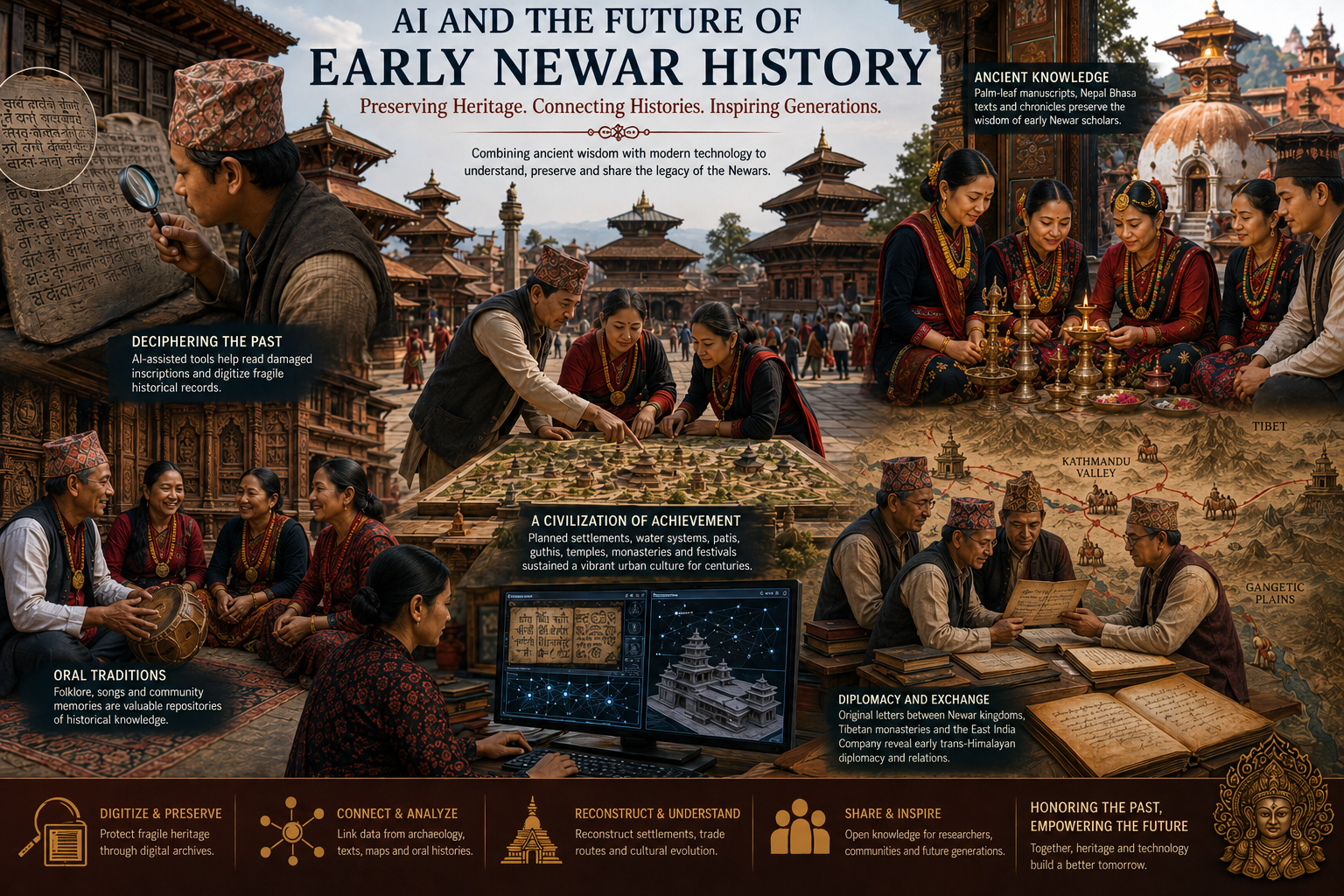
Artificial intelligence has the potential to transform historical research in several ways. AI-assisted systems can help scholars read damaged inscriptions, decipher faded manuscripts, digitize rare Nepal Bhasa texts, and connect archaeological findings with oral traditions that have been preserved for centuries. Advanced machine-learning techniques may also assist researchers in reconstructing ancient settlements, trade routes, and cultural networks, while identifying possible links between Kirata, Licchavi, and later Newar cultural developments.
This work is particularly important because much historical evidence has been lost, dispersed across different archives, damaged by time, or remains unpublished and inaccessible to researchers. By digitizing and integrating scattered sources, AI can help create a more comprehensive understanding of Nepal’s past.
Ancient Newars played a significant role in regional trade and cultural exchange. The Kathmandu Valley occupied a strategic position between the Gangetic plains, the Himalayan regions, and Tibet. Newar merchants traveled extensively across these networks, facilitating commerce, cultural transmission, artistic exchange, and religious interaction. These connections helped establish the Valley as an important center of learning, craftsmanship, diplomacy, and trade.
Newar society also developed one of South Asia’s most sophisticated urban cultures. Their achievements included carefully planned settlements, advanced water management systems, public rest houses (patis), community institutions (guthis), temples, monasteries, marketplaces, and festivals integrated into civic life. These institutions helped sustain vibrant urban communities for centuries and contributed to the resilience of Kathmandu Valley civilization.
The preservation of historical knowledge is another area where AI can make a significant contribution. By assisting human epigraphers, historians, and linguists, AI systems can help transform fragile palm-leaf manuscripts and handwritten documents into searchable, open-access digital resources. This transition from vulnerable physical records to digital knowledge repositories can ensure that the intellectual legacy of early Newar scholars remains accessible to researchers and future generations around the world.
Future research may also benefit from the analysis of historical correspondence preserved in archives across Nepal, Tibet, India, Britain, and elsewhere. Letters exchanged between Newar kingdoms, Tibetan monasteries, merchants, and officials of the East India Company may reveal new insights into trans-Himalayan diplomacy, trade networks, religious exchange, and political relationships.
Equally important are oral traditions. Rather than treating folklore, legends, and community narratives merely as fiction, researchers increasingly recognize them as structured repositories of historical memory. When combined with archaeological evidence and documentary sources, these traditions can help transform isolated discoveries into a more coherent narrative of long-term cultural evolution.
AI models can analyze large collections of oral histories, community songs, folklore, and interviews to identify recurring geographical references, ancestral names, migration patterns, and memories of historical events. Such analysis can help researchers generate new hypotheses and uncover connections that might otherwise remain hidden.
Ultimately, AI should not replace historians, archaeologists, linguists, or community knowledge holders. Instead, it should serve as a powerful tool that enhances human scholarship. By combining technological innovation with rigorous research and community participation, Nepal has an opportunity to preserve, understand, and share the remarkable legacy of Newar civilization while enriching our understanding of the diverse historical traditions that have shaped the nation.
ChatGPT and many other large language models (LLMs) can handle Nepali fairly well because there is a relatively large amount of Nepali text available online—spanning digital publications, social media, news websites, books, and translated datasets.
The Newar language (also known as Nepal Bhasa) faces a different challenge. Significantly less digital text is available for it compared to Nepali or English. Many historical documents are preserved in traditional manuscripts rather than machine-readable digital formats. Furthermore, different scripts have been used over time, including the Ranjana script and Prachalit Nepal Lipi. Consequently, there are fewer large-scale language datasets available for AI training, and limited funding and technical resources have been devoted to developing language technologies like speech recognition, machine translation, and LLM training for it.
The good news is that there is growing global interest in preserving low-resource and indigenous languages through AI. Researchers, universities, cultural organizations, and open-source communities are actively working on digitizing manuscripts and archives, creating Newar language corpora, developing dictionaries and parallel translation datasets, building speech and text datasets for AI training, and using AI-assisted transcription and translation tools to preserve cultural heritage.
For a community with such a rich literary and cultural history as the Newars, AI could become a powerful tool for language preservation and revitalization. This is also an area where Nepal could contribute significantly by creating digital archives, oral history collections, and annotated texts that future AI systems can learn from.
In fact, one of the most valuable contributions would be the systematic digitization of old Nepal Bhasa literature, inscriptions, manuscripts, folk stories, songs, and oral histories. Once enough high-quality digital content exists, future LLMs will be able to understand and generate Newar much more effectively than they do today. Supported by reliable funding sources, future AI systems could converse fluently in Nepal Bhasa, translate historical texts, and help preserve centuries of Newar knowledge for generations to come.