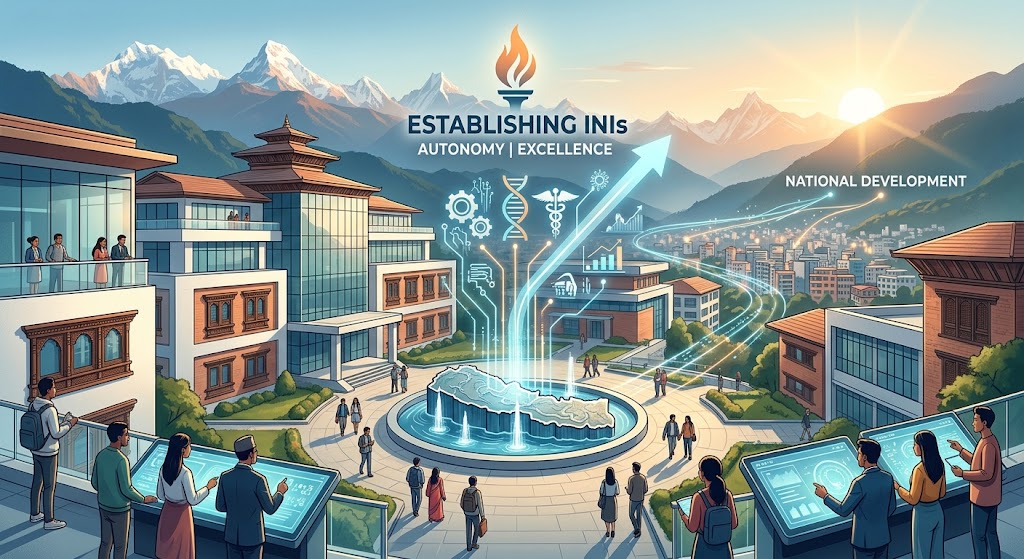
Nepal stands at a critical juncture in its national development. As the global economy undergoes a rapid transition driven by artificial intelligence, automation, and advanced technology, our nation's economic resilience depends entirely on how we develop our human capital. The engineering, IT, and medical sectors require a mass scale of highly skilled, problem-solving graduates capable of leading innovation.
Yet, premier state institutions like the Institute of Engineering (IOE), Pulchowk—alongside leading technical and medical faculties across Tribhuvan University—remain trapped in recurring structural and financial crises. Resolving these challenges requires moving past short-term fixes and implementing a long-term strategy centered on three interconnected pillars: statutory autonomy through an Act of Parliament, sustainable financial models built on transparent alumni ecosystems, and a scaled-up STE(A)M educational paradigm.
The Geological Context: High-Risk Terrain and Specialized Engineering Needs
Living on the collision boundary of the Indian and Eurasian tectonic plates makes Nepal one of the most geologically vulnerable nations on Earth.
The Multi-Hazard Reality of the Himalayan Bed
Standard engineering models designed for stable plains fail in Nepal's fragile ecology. The country faces an interconnected web of severe natural hazards with continuous tectonic convergence builds immense stress along active fault lines, triggering major earthquakes and extensive slope failures. Warming high-altitude temperatures destabilize glacial moraines, creating flash flood risks for downstream infrastructure and mountain communities. Heavy monsoonal rains on steep, seismically fractured terrain cause frequent landslides, mudflows, and river blockages.
Building resilient infrastructure, hydropower, roads, and human settlements on the bed of high mountain glaciers and fragile slopes requires highly specialized engineering expertise. This is precisely where premier institutions like IOE must lead. While Nepal's researchers and faculty are exceptionally talented, unlocking their potential to address these complex disaster-resilience challenges requires statutory empowerment.
- Declaring Premier Institutions as "Institutes of National Importance" (INI)
A fundamental flaw in premier state institutions is that they are currently governed under broad university administrative structures designed for general education rather than specialized technology hubs. Engineering and medical faculties face complex operational demands that require rapid decision-making, specialized research investments, and direct industry collaboration.
Since 1979, I have consistently advocated before stakeholders—including the University Grants Commission, National Planning Commission, ministries, university leadership, and student bodies—for a dedicated statutory framework. The Government of Nepal must enact a specialized Institutes of Special Technology Act through Parliament.
This Act should declare premier centers like IOE as Institutes of National Importance (INI), defining their powers, duties, and governance frameworks. Statutory Autonomy insulates premier faculties from political disruption and bureaucratic inertia, granting them the administrative flexibility to update curricula, manage infrastructure, and partner directly with global technology leaders. The nation’s top rankers—the "cream students"—represent vital national human capital. Educating them is a strategic state investment, not a consumer transaction. INI status legally commits the government to providing a dedicated budget for infrastructure, high-end research, and faculty development, preventing institutions from relying solely on steep tuition hikes that trigger student unrest. Policy Integration grants clear national recognition to state technical institutions as central players in executing Nepal's broader human capital development policies.
- Building Financial Sustainability: The Alumni Ecosystem
Financial sustainability is one of the most pressing challenges facing higher education today. Universities must build the capacity to generate operational and research revenue without total reliance on government grants.
Looking globally, institutions like the Indian Institute of Technology Kanpur (IITK) demonstrate the transformative power of a thriving alumni network. Supported in its early years by leading U.S. academic institutions, IITK cultivated a culture where "quality education paid." Alumni maintain a deep connection to their alma mater, contributing massive funds, time, and expertise. Alumni philanthropy funds critical initiatives that lack traditional state backing. Nepalese universities can build similar financial resilience by understanding what drives alumni giving. Alumni financial support relies on institutional trust.
- Scaling STE(A)M Education to Future-Proof the Workforce
Statutory autonomy and financial sustainability provide the foundation, but modernizing what and how we teach is equally critical. To prepare graduates for an AI-driven global economy, Nepal must scale up an integrated STE(A)M (Science, Technology, Engineering, Arts, and Mathematics) framework across all levels of education.
Moving from traditional rote learning to STE(A)M requires teacher Empowerment. Educators need training in collaborative, cross-subject co-teaching, pairing science and mathematics instructors with arts and humanities teachers. University-level teacher training models should expand across all provincial universities to build a nationwide pipeline of STE(A)M educators. Including the Arts (humanities, ethics, social context, and design thinking) ensures technology serves genuine human and community needs. As AI automates routine technical tasks, skills like critical thinking, ethical judgment, communication, and contextual reasoning become essential. Government innovation grants must link university research directly to national development priorities, giving students opportunities to build practical prototypes in renewable energy, localized software, and civil infrastructure.
Moving Forward
The path out of the crisis facing IOE and Nepal's higher education sector requires clear policy vision and coordinated execution. By granting our premier technical institutions autonomy through an Institute of National Importance Act, establishing transparent financial ecosystems backed by active alumni engagement, and scaling human-centered STE(A)M education, Nepal can build a resilient higher educational system capable of developing the skilled workforce required for the modern world.